Tabletop Fun from Simple Things
The dining table, once cleared of dinner plates, is the perfect blank canvas for structured, quiet play. Tabletop games provide a focal point that anchors the room, allowing people to drop in and out of the activity without disrupting the flow of the evening. Here, we outline three concrete activities based on standard objects found in most homes during the holidays.
The Christmas Card Memory Match
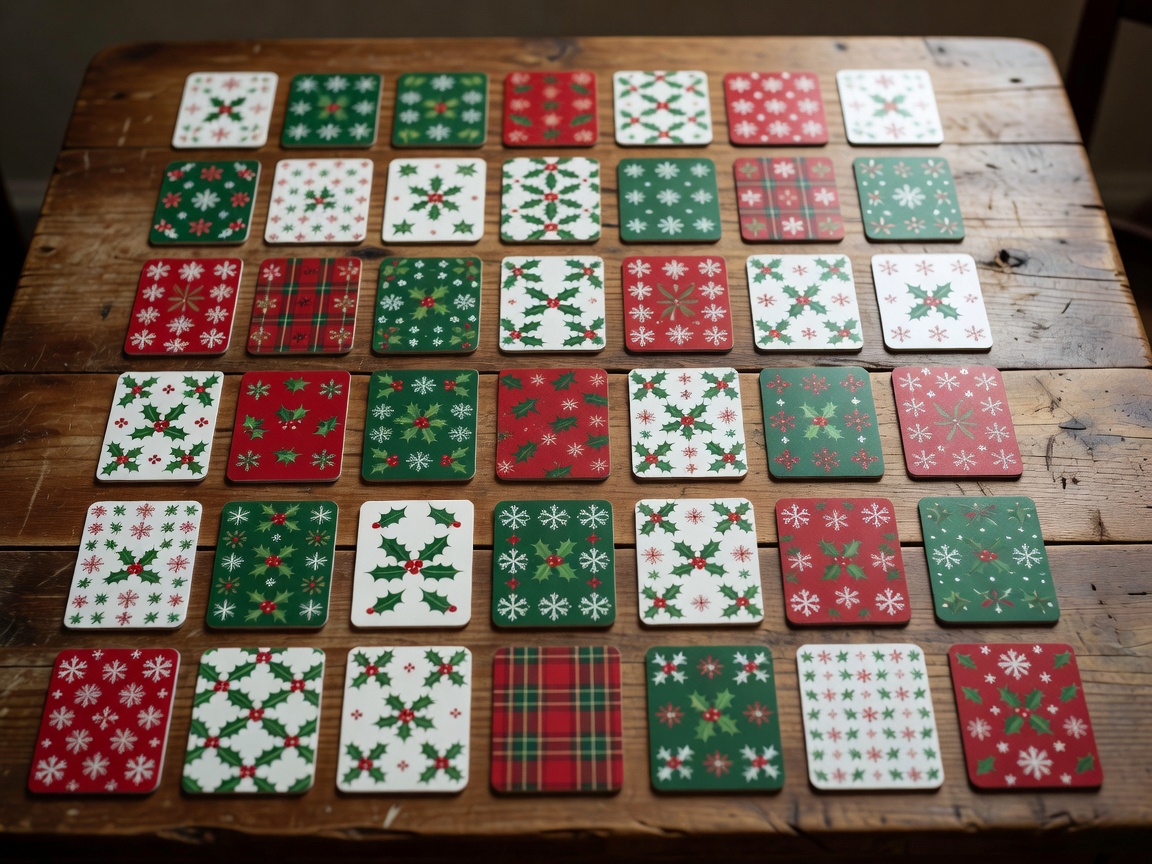
Using old holiday cards, you can easily construct a visually rich matching game. The tactile nature of thick cardstock and the familiar imagery make this far more engaging than a standard 52-card deck.
Materials to Gather
- 10 to 12 pairs of matching Christmas cards (or cut halves of identical scenes).
- A flat, clear tabletop surface.
- A small wooden counter to designate the active player's turn.
Preparation
- Select the cards you wish to use. If you do not have identical pairs, take a single card and cut it cleanly down the middle to create two halves that must be reunited.
- Shuffle the cards or halves gently.
- Lay them face down in a neat grid pattern. Ensuring the grid is symmetrical helps players orient their memory spatially.
Play
- The first player turns over two pieces, leaving them flat on the table so everyone can observe the imagery.
- If the images match (or form a whole card), the player moves those pieces to their collection pile and takes another turn.
- If they do not match, the player turns them face down in their exact original positions.
- The wooden counter is passed to the next player.
Standard Rule
Players keep the cards they match, and the person with the most pairs at the end wins.
Adaptation
Work collaboratively. All players attempt to clear the board in the fewest collective turns, removing the competitive edge entirely.
The Peppermint Grid
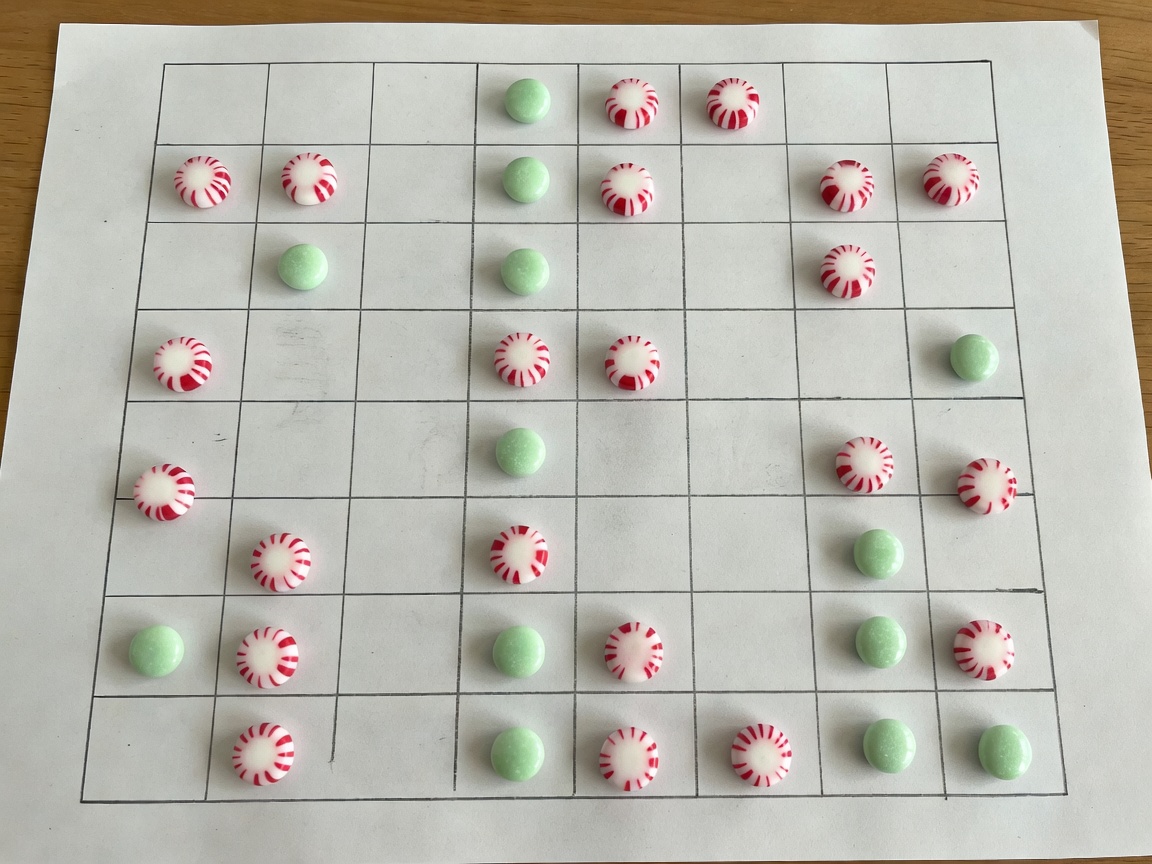
This is a variation of traditional alignment games (like Tic-Tac-Toe or Connect 4), scaled up slightly and utilizing seasonal sweets or wooden tokens.
Materials to Gather
- A large sheet of plain paper.
- A marker to draw the grid.
- Two distinct sets of tokens (e.g., wrapped red mints vs. wrapped green mints, or smooth pebbles vs. wooden blocks). 15 of each.
Preparation
- Draw a grid of 5 columns by 5 rows on the plain paper. Make the squares large enough to comfortably hold a token without crowding the lines.
- Place the two sets of tokens in shallow bowls on either side of the paper.
Play
- Players take turns placing one token into any empty square on the grid.
- The objective is to align four tokens of your color in a row—horizontally, vertically, or diagonally.
- Once a token is placed, it cannot be moved.
Standard Rule
First to align four wins the round. Clear the board and start again.
Adaptation
For younger players, reduce the grid to 3x3 and aim for three in a row, using Hoyle's classic principles of simplified alignment games.